Boushehr Province at a glance
Boushehr province with an area of 27653 sq km is located on the south of Iran, lying on the northern coastline of the Persian Gulf. It is bordered by Khouzestan and Kohgiloyeh – va – Boyerahmad provinces to the north, by Fars province to the east, by Hormozgan province on its southeast, and by the Persian Gulf on the south and the west.
The population of the province stands at 743,675 people (1996 census ). Almost all the population of the province speak Farsi with southern accents. Some inhabitants at Shif, Kangan and Assaluyeh also speak Arabic.
The resistance of people of Boushehr, and brave warriors especially Tangestan, against foreign invaders,formed an important part of the Iran’s contemporary history and has left lasting memories for the people.
Boushehr province with more than 600 Km border with the Persian Gulf, consists of 9 township and 22 cities. Its townships are Boushehr (province’s center), Dashhtestan, Dashti, Tangestan, Genaveh, Kangan, Dayer, Daylam, Jam and Riz.
![]()
South Pars Gas Field
South Pars gas field is the largest independent gas reserve in the world which is shared by Iran and Qatar. The field is 105 kilometers away from the Pars Special Economic Energy Zone. The reservoir covers 9,700 square kilometers in total with 3,700 square kilometers blongingto Iran. According to latest figures, the field contains more than 51 trillion cubic meters of natural gas . It stands for about 48 percent of Iran’s confirmed reserves.
Considering the vast area of this gas field, its development was planned in several phases. The aim of developing of South Pars is supplying the increasing demand for the natural gas required for the country’s domestic consumption, injecting gas into the oil fields, and exporting gas and condensates. Supplying gas as feedstock for the petrochemical industry is on the agenda of the National Iranian Oil Company (NIOC).
The field is already being developed in different phases; so far 14 gas processing plants have been planned. With regards to the reservoir’s capacity, the development phases can increase to 28 phases or even more to further develop the giant gas field.Meanwhile,15 huge petrochemical complexes and a wide range of downstream petrochemical units, different related industries, semi-heavy industries, marine industries and considerable number of service related facilities are predicted in this zone.
Area and Boundaries
The zone is bounded on the north by the Zagros Mountains, on the south by the Persian Gulf, on the west by the village of Shirino and on the east by the village of Chah Mobarak.
The total area is approximately 14,000 hectares. excluding the alluvial lands and environmentally protected territories,there will remain about 10,000 hectares of developmental lands.
![]()
Preserved Land
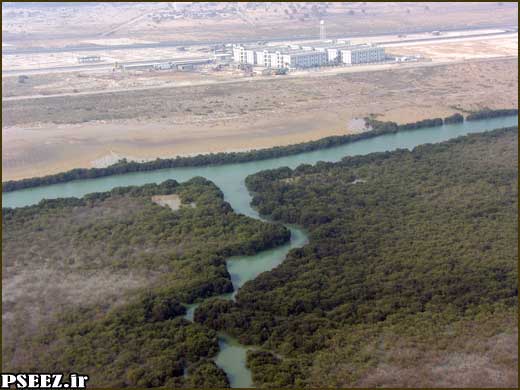
The Nayband Bay is one of the most unique protected areas in the south of Iran for the habitat and breeding of marine life as well as mangrove trees.
Furthermore, the lands on the south of the Gavbandi River and south-east of the PSEEZ are declared as Preserved Lands by the Environmental Protection Organization of Iran.
Climate
• Located on the27 Degree latitude and 52 degree longitude.
• Air temperature of between 5 to 50 degrees centigrade.
• Relative humidity of 59 to 88 percent.
• Mean annual rainfall of 80 mm.
• The natural slope of the land starts from 0.1% (On the coastline) and reaches to 8% (on the mountain foot).
• Ground water reservoir of – 1.0 to – 10.0 m.
• Average and scattered vegetation with some densely covered palm and mangrove trees.
• Predominant wind due to the particular local topography is from northwest to southeast.